X 2 Y 2 16

vaxvolunteers
Mar 17, 2026 · 7 min read
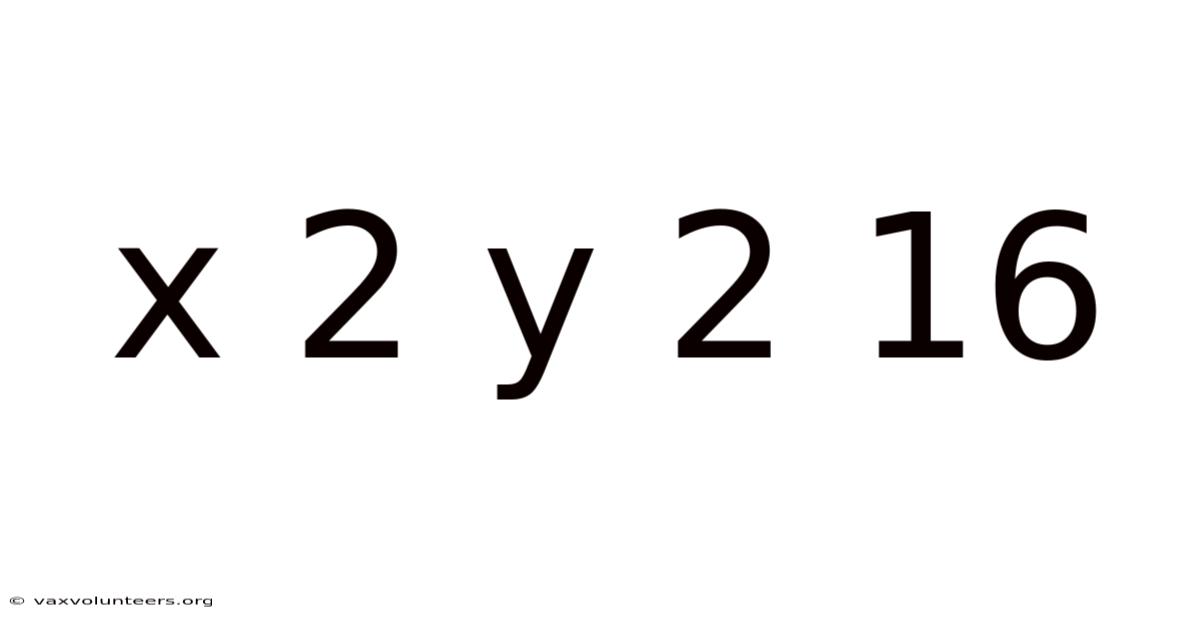
Table of Contents
Understanding the Circle: The Power and Meaning of x² + y² = 16
At first glance, the string of characters x² + y² = 16 might seem like an abstract puzzle, a cryptic code from a mathematics textbook. However, this deceptively simple equation is a gateway to one of the most fundamental and elegant shapes in geometry: the circle. More specifically, it is the precise algebraic recipe for drawing a circle with a radius of 4 units, centered perfectly at the origin (0,0) of a standard Cartesian coordinate plane. This article will unpack this equation in its entirety, transforming it from a mere formula into a rich conceptual tool. We will explore its geometric meaning, its derivation, its practical manifestations in the world around us, and the common pitfalls that learners encounter. By the end, you will not only know what x² + y² = 16 represents but also appreciate its foundational role in bridging algebra and geometry.
Detailed Explanation: Deconstructing the Equation
To understand x² + y² = 16, we must first recognize it as a specific instance of the general form of a circle's equation: (x - h)² + (y - k)² = r². In this standard template, (h, k) represents the coordinates of the circle's center, and r represents its radius. The equation x² + y² = 16 is what we call the standard form for a circle centered at the origin. Here, h = 0 and k = 0, so the (x - 0)² and (y - 0)² simplify neatly to x² and y². The number on the right side of the equals sign, 16, is not just any number—it is the square of the radius. Therefore, r² = 16, which means the radius r is the positive square root of 16, which is 4.
The profound beauty of this equation lies in its direct application of the Pythagorean Theorem. Every point (x, y) that satisfies this equation lies exactly 4 units away from the origin (0,0). If you draw a line from the origin to any such point (x, y), that line is the hypotenuse of a right triangle. The legs of that triangle have lengths |x| (the horizontal distance from the y-axis) and |y| (the vertical distance from the x-axis). The Pythagorean Theorem states that for any right triangle, (leg₁)² + (leg₂)² = (hypotenuse)². Substituting our values gives x² + y² = 4², which is x² + y² = 16. Thus, the equation is a direct algebraic translation of the geometric definition of a circle: the set of all points equidistant from a fixed center point.
Step-by-Step Breakdown: From Concept to Graph
Let's walk through the logical process of moving from the abstract equation to a concrete visual representation.
Step 1: Identify the Center and Radius.
First, confirm the equation is in the correct form. x² + y² = 16 matches (x - 0)² + (y - 0)² = 4². This immediately tells us:
- Center:
(0, 0)— the origin. - Radius:
r = √16 = 4.
Step 2: Plot the Center and Mark the Radius.
On graph paper or a coordinate plane, place a clear point at (0,0). From this center, measure 4 units in the four cardinal directions: up to (0,4), down to (0,-4), right to (4,0), and left to (-4,0). These are your intercepts—the points where the circle crosses the axes. Plotting these four anchor points provides a rough skeleton of the circle.
Step 3: Utilize Symmetry.
A circle centered at the origin is perfectly symmetric across both the x-axis and the y-axis. This means if (x, y) is a point on the circle, then so are (-x, y), (x, -y), and (-x, -y). After plotting your four intercepts, you can use this symmetry to sketch a smooth, round curve through them. For greater accuracy, you can find additional points. For example, when x = 2, solve for y: (2)² + y² = 16 → 4 + y² = 16 → y² = 12 → y = ±√12 ≈ ±3.46. So (2, 3.46) and (2, -3.46) are points on the circle. Finding a few more such points will help you draw a more precise circle.
Step 4: Draw the Circle.
Using a compass (if working on paper) set to a 4-unit radius, place its point on the origin and draw. If sketching freehand, use your plotted points and symmetry to create the smoothest possible curve, ensuring it is round and not oval-shaped. The final shape is the graphical solution set to the equation x² + y² = 16.
Real-World Examples: Where This Equation Applies
This isn't just theoretical. The circle defined by x² + y² = 16 (or circles of any radius) is a blueprint found in countless practical and natural contexts.
- Engineering and Design: The wheels on a car, the gears in a machine, and the lids of jars are all designed as circles. An engineer might use the equation
x² + y² = r²to model the boundary of a wheel with a 4-inch radius in a computer-aided design (CAD) program. The equation ensures perfect circularity, which is critical for smooth rotation and balance. - Astronomy and Physics: The orbits of planets, while elliptical, are often approximated as circular for basic models. If we simplified Earth's orbit around the sun (ignoring elliptical eccentricity) and set a scale where 1 unit = 1 million miles, a simplified circular orbit model might use an equation like
x² + y² = (93)²(since the average radius is ~93 million miles). The principle is identical to ourx² + y² = 16. - Architecture and Art: The famous circular windows in Gothic cat
hedrals—think of the iconic rose windows, whose intricate tracery radiates from a central point, each pane of glass forming part of a perfect circle. Stained glass artisans rely on geometric precision, often using a compass and the very equation x² + y² = r² to lay out their designs, ensuring harmony and balance in their sacred geometry.
Beyond architecture, the circle's equation manifests in physics and wave propagation. When a pebble drops into a still pond, the ripples expand as concentric circles. At any moment, the crest of a wave front can be modeled by x² + y² = (vt)², where v is the wave speed and t is time—a direct analog to our static circle equation. In computer graphics and gaming, this equation is fundamental for collision detection, rendering circular sprites, and defining hitboxes. A programmer might check if a point (x, y) lies within a circular boundary by testing if x² + y² ≤ r², a computationally efficient check derived directly from our model.
Even in everyday design, from the circular face of a watch to the rim of a coffee cup, the principle is the same. The equation x² + y² = 16 is not an isolated artifact; it is a specific instance of a universal template for circularity. Its simplicity belies its power—a single algebraic statement that captures a shape fundamental to both natural phenomena and human invention.
Conclusion
The circle defined by x² + y² = 16 is more than a graph on a coordinate plane; it is a mathematical embodiment of symmetry, efficiency, and perfection. From the four cardinal intercepts plotted with precision to the smooth curve drawn through countless symmetric points, the process of graphing reinforces a deep truth: complex, continuous forms can arise from simple, elegant rules. This equation serves as a foundational bridge between abstract algebra and the tangible, circular patterns that permeate our world—from the gears that drive machinery to the orbits that govern planets, from the sacred windows of medieval cathedrals to the digital realms of modern technology. By understanding this one equation, we gain a lens through which to see the hidden geometry structuring reality itself, reminding us that the language of mathematics is, in many ways, the language of the universe.
Latest Posts
Latest Posts
-
Identity Vs Role Confusion Example
Mar 17, 2026
-
9 Gallons How Many Quarts
Mar 17, 2026
-
Why Are Coral Reefs Important
Mar 17, 2026
-
15 Divided By 1 3
Mar 17, 2026
-
174cm In Ft And Inches
Mar 17, 2026
Related Post
Thank you for visiting our website which covers about X 2 Y 2 16 . We hope the information provided has been useful to you. Feel free to contact us if you have any questions or need further assistance. See you next time and don't miss to bookmark.
