X 2 3x 2 0

vaxvolunteers
Mar 14, 2026 · 3 min read
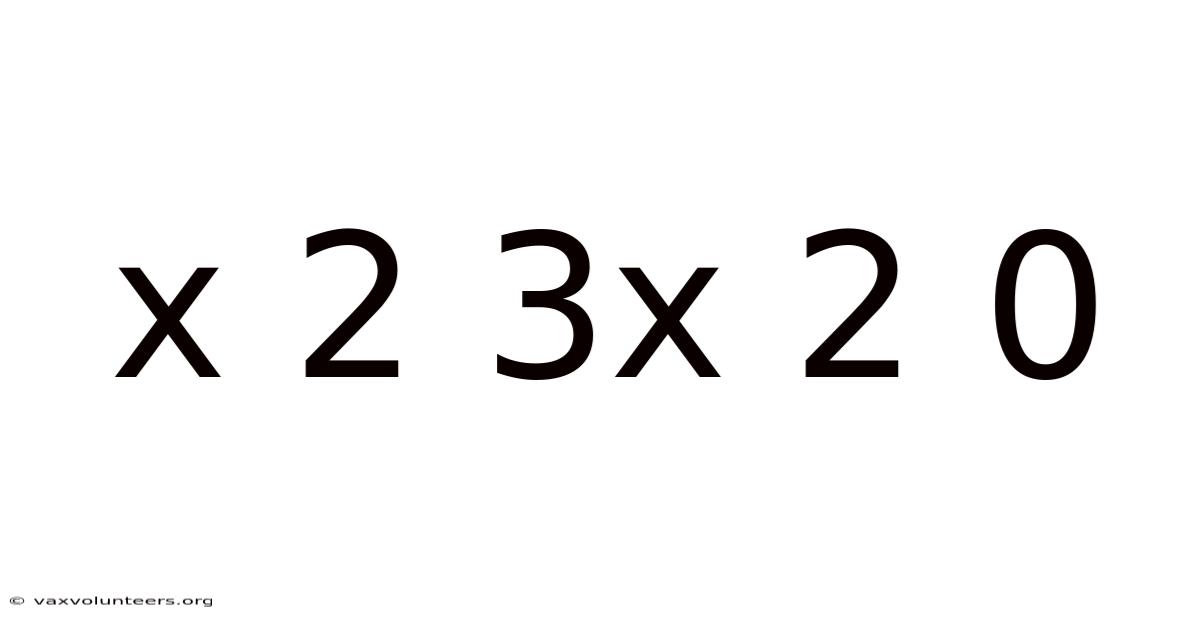
Table of Contents
Understanding Quadratic Equations: A Comprehensive Guide to Solving x² + 3x + 2 = 0 and Beyond
Introduction: The Power of Quadratic Equations
Quadratic equations are foundational in mathematics, appearing in everything from basic algebra to advanced physics and engineering. At their core, these equations take the form ax² + bx + c = 0, where a, b, and c are constants, and a ≠ 0. The equation x² + 3x + 2 = 0 exemplifies this structure, with a = 1, b = 3, and c = 2. Solving such equations unlocks insights into parabolic motion, economic models, and even the design of bridges and satellite dishes. This article will explore the theory, methods, and real-world applications of quadratic equations, using x² + 3x + 2 = 0 as a guiding example.
Detailed Explanation: Breaking Down the Components
What Is a Quadratic Equation?
A quadratic equation is a second-degree polynomial equation, meaning the highest exponent of the variable (x) is 2. The general form is:
ax² + bx + c = 0
Here:
- a is the coefficient of x² (the quadratic term),
- b is the coefficient of x (the linear term),
- c is the constant term.
Solving Methods: From Factoring to the Quadratic Formula
Several systematic approaches exist for solving quadratic equations, each with its own advantages. For x² + 3x + 2 = 0, the simplest method is factoring. We seek two numbers that multiply to c = 2 and add to b = 3. These numbers are 1 and 2, allowing us to rewrite the equation as (x + 1)(x + 2) = 0. By the zero-product property, this yields two solutions: x = -1 and x = -2.
When factoring is not straightforward, completing the square provides a universal technique. Starting with x² + 3x = -2, we take half of b (which is 3/2), square it (9/4), and add it to both sides:
x² + 3x + 9/4 = -2 + 9/4
This simplifies to (x + 3/2)² = 1/4. Taking the square root of both sides gives x + 3/2 = ±1/2, leading again to x = -1 and x = -2.
The most powerful and widely applicable method is the quadratic formula:
x = [-b ± √(b² - 4ac)] / (2a)
Derived from completing the square, it works for any quadratic. For our example, with a=1, b=3, c=2:
Discriminant = b² - 4ac = 9 - 8 = 1.
Thus, x = [-3 ± √1] / 2 = (-3 ± 1)/2, confirming the roots x = -1 and x = -2.
The Discriminant: Predicting the Nature of Solutions
The discriminant (Δ = b² - 4ac) determines the type and number of solutions without full calculation:
- Δ > 0: Two distinct real roots (as in our example, where Δ = 1).
- Δ = 0: One repeated real root.
- Δ < 0: Two complex conjugate roots.
This insight is crucial in fields like engineering, where real roots might represent feasible physical dimensions, while complex roots indicate an unrealistic scenario under given constraints.
Real-World Applications: Beyond the Abstract
Quadratic equations model countless phenomena. In physics, the trajectory of a projectile follows a parabolic path described by a quadratic equation, with roots indicating when the object hits the ground. In economics, profit maximization problems often lead to quadratics, where the vertex
Latest Posts
Latest Posts
-
Neutralization Theory Points Out That
Mar 14, 2026
-
Is 6 8 Greater Than 3 4
Mar 14, 2026
-
What Is 80 Of 150
Mar 14, 2026
-
Sudden Wind Gusts On Highways
Mar 14, 2026
-
What Does 12 6 Sign Mean
Mar 14, 2026
Related Post
Thank you for visiting our website which covers about X 2 3x 2 0 . We hope the information provided has been useful to you. Feel free to contact us if you have any questions or need further assistance. See you next time and don't miss to bookmark.
